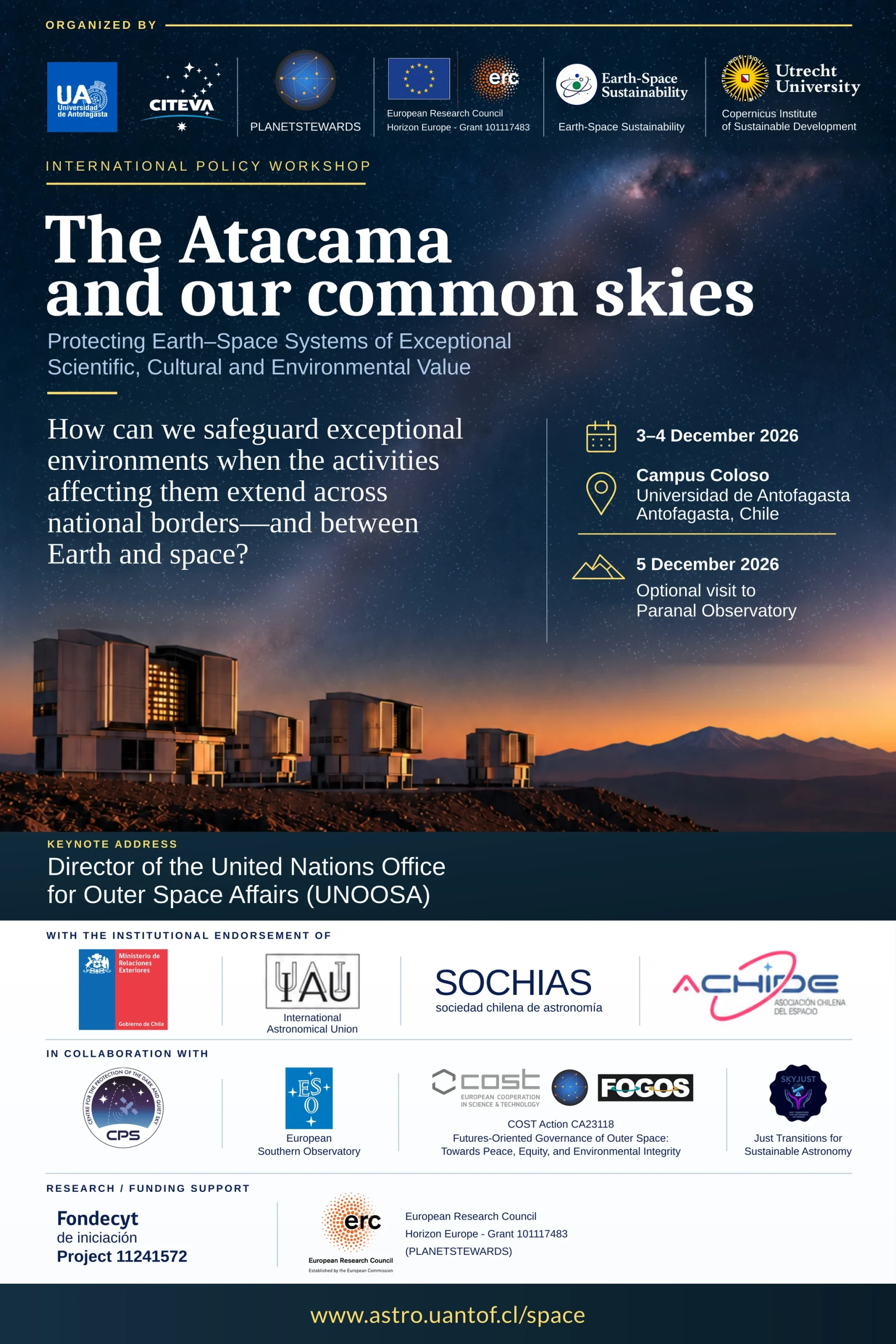
International policy workshop · Antofagasta, Chile
The Atacama and
our common skies
Protecting Earth-Space Systems of Exceptional Scientific, Cultural and Environmental Value
An international policy workshop on Earth-Space governance, Dark and Quiet Skies, and the protection of irreplaceable environments.
- Workshop
- 3–4 December 2026Thursday afternoon & Friday
- Venue
- Campus Coloso · Universidad de AntofagastaAntofagasta, Chile
- Participation
- By invitation · about 40 participantsWorking language: English
Conveners
Main organizers
Universidad de Antofagasta
Centro de Astronomía (CITEVA)
Host institution · Antofagasta, Chile
PLANETSTEWARDS
Copernicus Institute of Sustainable Development
Utrecht University, the Netherlands
Earth-Space Sustainability (ESS) Network
Copernicus Institute of Sustainable Development
Utrecht University, the Netherlands
The rationale
Protecting our common skies.
How can we protect the conditions that sustain the Atacama’s exceptional scientific, cultural and environmental value as pressures from terrestrial development and space activities become increasingly interconnected, transboundary and cumulative?
The Atacama combines extreme natural conditions with world-class astronomical infrastructure. Industrial development, light pollution and orbital activities place pressure on its observing environments and the values associated with its skies. Chile’s protection framework, including the Astronomical Areas declared in 2023, provides a basis for addressing these challenges.
Satellite constellations, radio-frequency interference, potential orbital advertising and reflective structures also link local protection to decisions taken elsewhere.
This international workshop provides a forum to discuss the governance implications of competing activities affecting the region, policy responses from Chile, and the national and international cooperation needed to safeguard the Atacama. Participants will develop actionable policy recommendations grounded in this experience to protect the common values that local and global communities associate with its skies.
Our ambition
From shared concern to practical protection.
The Atacama is a lived and working territory. Its skies have scientific, cultural, spiritual, ecological and community significance; protecting them involves scientific and environmental integrity, as well as social-cultural justice.
Indigenous and local communities, cities, astronomical observatories, mining and energy industries, and transport and communications infrastructure coexist with ecosystems adapted to extreme conditions. A shared assessment must therefore consider both the conditions to protect and the ways in which sustainable activities can coexist.
Bringing together Chilean regulatory experience, diplomatic and legal expertise, scientific and community knowledge, and the perspectives of observatories and industry, the workshop will assess diverse values and terrestrial and orbital pressures, identify governance gaps, and develop policy responses for Chile and international cooperation.
The Atacama Declaration
The workshop will result in an Atacama Declaration with a synthesis text, along with three interconnected policy briefs addressing each of the three objectives. Recommendations will shed light on policy action in Chile, cooperation among states, scientific coordination and operator design and practices.
Methodology & policy laboratories
A collaborative process
Three policy laboratories bring together continuous working groups before and during the workshop. They assess diverse values, examine terrestrial and orbital pressures, and develop policy responses. Each prepares two to four actionable recommendations, contributing to a common Atacama Declaration.
An inclusive assessment approach to sky governance
This laboratory develops a locally grounded assessment approach for the Atacama skies: what should be protected, whose knowledge and values enter the assessment, and how priorities should be established. It considers scientific value alongside cultural, spiritual, ecological and community relationships with the sky. Its recommendations address diverse values and interests, qualitative indicators and criteria for priority-setting, informing the other laboratories.
Space Court Foundation Martin Sanzana Calvet Copernicus Institute of Sustainable Development
Utrecht University, the Netherlands
Assessing Earth-Space sustainability
This laboratory assesses how terrestrial and orbital activities affect the Atacama’s observing conditions, including optical and radio interference, brightness, reflectivity and cumulative impacts. It examines independent monitoring, ephemerides and other data sharing, operator practices and voluntary measures. Drawing on technical assessments, it considers trade-offs and policy responses that align environmental thresholds and acceptance levels with the diverse values identified in Laboratory 1.
Universidad de Antofagasta, Chile Second Co-lead To be confirmed
Deriving policy recommendations for Chilean and global sky governance
This laboratory identifies governance gaps and develops a roadmap for a Chilean national sky governance strategy and the international cooperation needed to support it. It draws on national, regional and international policy reports to identify actors, instruments and timelines. Inputs from Laboratories 1 and 2 inform its recommendations on diverse values, pressures across Earth-Space systems and criteria for priority-setting.
Vilnius University, Lithuania
Programme at a glance
Two working days in Antofagasta.
Keynote · Friday 4 December, morning
Aarti Holla-Maini
The Director of the United Nations Office for Outer Space Affairs will deliver a keynote address at the event.
The keynote and institutional dialogue will precede the final laboratory sessions, allowing their contributions to inform the policy briefs and the Atacama Declaration.
Plenary discussions and laboratory review
Registration and welcome; plenary discussions on the Atacama as a contested astronomical territory and on Dark and Quiet Skies; parallel laboratory work on the policy briefs and proposed amendments to the Declaration; joint report-back.
Dialogue, deliberation and outcomes
Formal opening; UNOOSA keynote; the international institutional landscape; laboratories and rapporteur report-backs; joint deliberation on the Declaration, principal findings and next steps; formal closing.
Visit to ESO’s Paranal Observatory
An optional visit for up to 40 participants. The visit and transport are covered by the organizers. Places are allocated separately from workshop participation. See the visit information below.
Three plenary discussions
The workshop will consist of three plenaries. Speakers will receive the preliminary questions in advance, and their contributions will inform the subsequent laboratory discussions.
A. The Atacama as a contested astronomical territory
Examines the Atacama’s scientific importance, the arrangements enabling international astronomy in Chile, the 2023 Astronomical Areas and current development pressures. Building on the July 2026 expert meeting, it brings observatory, regulatory, regional and community perspectives to questions of authority, access, benefit and participation.
B. Dark and Quiet Skies: evidence, mitigation and governance
Reviews optical and radio impacts, satellite brightness and reflectivity, orbital advertising and cumulative effects, distinguishing measurable impacts, projections and evidence gaps. It connects mitigation limits, monitoring, indicators, thresholds, data sharing and operational practices with policy choices for protecting the Atacama’s observing environments.
C. The international institutional landscape
Examines the roles of UNOOSA, COPUOS and its subcommittees, the IAU and CPS, national space institutions and regulators, and cooperation among states. It considers technical guidance, voluntary practice and regulatory instruments, identifying routes for recommendations and ways to make space-sector development compatible with ground-based astronomy.
Detailed programme · Thursday 3 December
| Time | Session |
|---|---|
| 13:30–14:00 | Registration. |
| 14:00–14:20 | Welcome: preparation to date, drafts for discussion, and outstanding decisions. |
| 14:20–15:30 | Plenary A: The Atacama as a contested astronomical territory. |
| 15:30–15:50 | Break. |
| 15:50–17:00 | Plenary B: Dark and Quiet Skies: evidence, mitigation and governance. |
| 17:00–17:45 | Parallel laboratories: review and revise the respective policy briefs in light of Plenaries A and B and identify proposed amendments to the Declaration. |
| 17:45–18:00 | Joint report-back: changes to policy briefs, cross-laboratory questions, suggestions for amendments to the Declaration. |
Detailed programme · Friday 4 December
| Time | Session |
|---|---|
| 09:00–09:20 | Formal opening and institutional remarks. |
| 09:20–10:00 | UNOOSA keynote and moderated exchange. |
| 10:00–10:15 | Break. |
| 10:15–11:15 | Plenary C: The international institutional landscape. |
| 11:15–12:45 | Parallel laboratories: consider keynote and Plenary C input, address outstanding questions in respective policy briefs and propose amendments to the Declaration. |
| 12:45–13:45 | Lunch. |
| 13:45–14:45 | Rapporteur report-backs on proposed amendments to the Declaration. |
| 14:45–15:00 | Break. |
| 15:00–16:45 | Further deliberation on amendments, consensus-building on priorities and wording, and unresolved issues. |
| 16:45–17:15 | Confirm the status of the Declaration and agree on consultation, endorsement and follow-through. Presentation of the principal findings. |
| 17:15–17:30 | Formal closing. |
Taking part
Participation & expressions of interest.
Participation is by invitation. The workshop accommodates about 40 participants, with work conducted in English through written contributions, feedback and short online discussions.
People interested in contributing are welcome to contact the organizers. Please include a short introduction, your affiliation where applicable, the perspective or expertise you would bring, and the policy laboratory or laboratories that interest you.
Expressions of interest are not registrations and do not guarantee an invitation. Participation and practical arrangements will be confirmed individually.
Email the organizing teamTo: Eduardo Unda-Sanzana, Xiao-Shan Yap and Penélope Longa-Peña.
Suggested subject: Atacama workshop 2026 — expression of interest
Optional field visit
From policy discussions to the observing site.
Saturday 5 December · Paranal Observatory
ESO will host an optional visit to Paranal Observatory for up to 40 participants in the late afternoon and evening. The programme includes the opening of the telescopes, sunset and observation of the night sky with the unaided eye.
The visit is free of charge. Transport will be arranged and covered by the workshop organisers. Places will be allocated separately from workshop participation; the detailed itinerary and joining instructions will be circulated to the visiting group.
This email is addressed to Eduardo Unda-Sanzana, Xiao-Shan Yap and Penélope Longa-Peña.
People & institutions
Convened through collaboration.
Institutional endorsements
Government of Chile

Institutional endorsement supports the convening of this workshop. It does not imply endorsement of every contribution or of the eventual declaration and recommendations.
In collaboration with
IAU CPS
IAU Centre for the Protection of the Dark and Quiet Sky
ESO
European Southern Observatory
FOGOS
COST Action CA23118
Futures-Oriented Governance of Outer Space: Towards Peace, Equity, and Environmental Integrity
SKYJUST
Just Transitions for Sustainable Astronomy
Organizing team
Research & institutional support
The workshop draws on the work of PLANETSTEWARDS and FONDECYT de Iniciación project 11241572, and the support of the Universidad de Antofagasta through CITEVA.
PLANETSTEWARDS is supported by the European Research Council under Horizon Europe (grant agreement 101117483).
Before you arrive
Venue, conduct & practical information.
Campus Coloso
Universidad de Antofagasta
Avenida Universidad de Antofagasta 02800
Antofagasta, Chile
The meeting room, campus directions and arrival information will be provided to confirmed participants.
Accessibility & participation arrangements
Please contact the organizers about access requirements or other arrangements that would help you take part. The working language is English.
Code of conduct
We are committed to a respectful environment free from discrimination, harassment, bullying and retaliation. Participants, organizers and session chairs are expected to comply with the IAU Code of Conduct, including its Anti-Harassment Policy, throughout workshop-related activities.
Concerns may be raised with an organizer, following the reporting procedures in the IAU policy.
Participants will agree on attribution and confidentiality, and their consent will be required for any recording or automated processing.